Monday, September 28, 2020

Hard Topics

 “I used to think ___________, but now I know ________________ .”

When I think of this statement, many topics come to mind that could be inputted into both blanks, but there are two topics that stick out further than others in regards to physics, mechanics, and/or mathematics. "I used to think physics and mathematics were both very difficult to comprehend, but now I know much more about solving equations in both fields". Now that I have taken both mathematics and physics courses during my undergrad and masters degree programs through Embry-Riddle, I feel like that I have a much better understanding of the two topics. I found taking classes with Embry-Riddle is very beneficial and helpful by taking me down the right path in showing me sources to help better understand the concept, such as performing various equations and formulas in Excel. Even though I had somewhat difficulty with producing an operational airport simulation model, I feel like I have a better understanding of the AnyLogic program now than I did before taking this class. 


Saturday, September 19, 2020

Addressing Complexity

        The relationship between the systems engineering filed and the theory of complexity is just the beginning (Honour, n.d.). Complexity is usually defined in terms of the use of agents, local information, reflex, and adaption. Some see complex systems as having so many components that are difficult or impossible to model (Castellani, n.d.). Other see that interacting components tend to produce unexpected properties that make overall system tough to model. Others still see complex systems as interfaces between humans, technology, and nature. 


        Systems engineering has been around for about 50 years and is still treated and learned by each practitioner during experimenting during a career. Complexity within systems engineering is somewhat newer than actual systems engineering. Complexity is determined by the extremes of chaos, which deals with situations in which behavior of the elements is completely unpredictable. The field of complexity has often been characterized as operating at the edge of chaos between extremes and occurs in systems that have sufficient chaos to be confusing, yet sufficient enough to provide patterns that are recognizable. 


References

Castellani, B. (n.d.). Kent State University. Complexity and its Implications to the Systems Engineering. Retrieved from https://www.incose.org/docs/default-source/cleveland-northern-ohio/castellani-on-complexity-and-its-implications-to-the-systems-engineering-process.pdf?sfvrsn=4

Honour, E. (n.d.). University of South Australia. Systems Engineering and Complexity. Retrieved from http://citeseerx.ist.psu.edu/viewdoc/download?doi=10.1.1.513.1309&rep=rep1&type=pdf


Sunday, September 6, 2020

Statistics in Action

For this week's blog, we are required to provide an example of statistics in action and how the way it shows its applicability in any context. I decided to use well known COVID-19 that seems to be the main daily discussion as an example of how the virus is applicable in affecting the economy. COVID-19 has disrupted the global supply of goods, making it harder for the United States firms to fill orders and has also laid off workers in various areas, reducing labor supply from one end of the country to the other (Vinelli, 2020). Statistics is a form of mathematical analysis that uses quantified models, representations and synopses for a given set of experimental data or real-life studies (Grant, 2019). The economic crisis caused by the outbreak of COVID-19 is hurting economies, regardless of income level. The data from United Nations Industrial Development Organization (UNIDO)'s  seasonally adjusted Index of Industrial Production (IIP) (April 2020 vs. December 2019) indicates both lower and upper middle-income countries have been impacted significantly by COVID-19. Below is a table showing the average loss in percentage in the IIP across countries. 

A health pandemic or a pandemic for the economy? April 2020 and some early evidence of firms’ perceptions

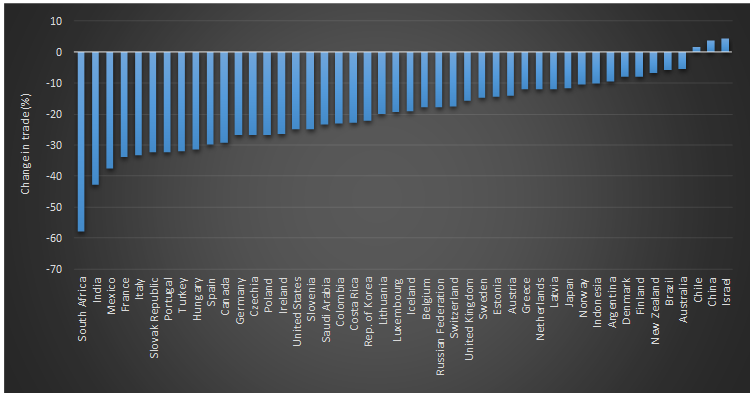
From a statistics standpoint, COVID-19 has also created trade losses for nearly all high and lower income countries between March and April 2020. South Africa, India, Mexico, France and Italy are the five countries that suffered the highest reductions in trade volume from March to April 2020. Below is a figure showing a change in trade goods in percentage by country from March to April 2020.

A health pandemic or a pandemic for the economy? April 2020 and some early evidence of firms’ perceptions


References

Grant, M. (2019, April 9). Investopedia. Statistics. Retrieved from https://www.investopedia.com/terms/s/statistics.asp#:~:text=Statistics%20is%20a%20form%20of,Mean

Vinelli, A. (2020, March 6). American Progress. The Economic Impact of Coronavirus in the U.S. and Possible Economic Policy Responses. Retrieved from https://www.americanprogress.org/issues/economy/news/2020/03/06/481394/economic-impact-coronavirus-united-states-possible-economic-policy-responses/


Tuesday, August 18, 2020

Module 2 Blog: Probability in Action

Provide an original example of the concept that shows its applicability in any context (e.g., work, academia, industry, government, personal life, and society).

Balancing work with life can be a taunting task at times due to the fact that money may come first and be more important than spending time with family. Although, many people choose to work a lot to make sure all bills are being paid for, which can interfere with life events in the process. While some careers allow a relaxed relationship between work and private life, many others demand significant reductions in the area of leisure and family (Ionos, 2019). Therefore, having an effective work-life balance is critical for everyone and people need to ensure to find ways to help overcome these challenges. There can be different ways in the applicability of work versus personal life. 

An increasing number of companies are relying on their employees to lead a more balanced lifestyle, as balanced, happy employees are ultimately more productive and motivated. If a company decides to destroy and interfere with an employee’s private life with too much overtime or a great amount of pressure, it will eventually result in no satisfaction and stress that can then lead to health problems, decreased productivity, and possibly leaving the company. To help with balancing work and life, be creative in shifts and hours by asking the employee things that need to be completed during a normal work day, including kid's school activities or taking college classes (Shepherd, 2019). Work with the employee to come up with a plan and during employee reviews, ensure to check in and see if the schedule needs or has changed. Taking steps like these will help mitigate a work-life balance. 

References
Ionos. (2019, March 14). Productivity. Work-Life Balance. Retrieved from https://www.ionos.com/startupguide/productivity/work-life-balance/

Shepherd, S. (2019, September 4). When I Work. 5 Ways to Promote Work-Life Integration Among Your Employees. Retrieved from https://wheniwork.com/blog/work-life-integration

Test

**TEST TEST TEST**

Wednesday, August 12, 2020